
We’ve thought much about music listening in the past articles, but now it’s time to dive into the brains of musicians. How does being a musician affect the brain differently?
In this meta-analysis, through analyzing many neuroimages to find out the differences between the brains of musicians and non-musicians, and how they react to music differently. What they uncovered was that musicians had higher activity in auditory, sensorimotor, interceptive, and limbic brain areas, but they surprisingly had lower activity(in comparison to the non-musicans) in the parietal areas. Fascinating, isn’t it? This means that musicians don’t need to work as hard to analyze the sounds specifically, because it’s coming almost second nature to them. The specialized areas(the auditory/sensorimotor) are already doing most of the work. The parietal lobe is also known for trying to mentally localize where the sound is coming from, and since this area is of lower activity in musicians’ brains, we can conclude that they have already internalized the music so deeply that they aren’t in need of the conscious spatial analysis.
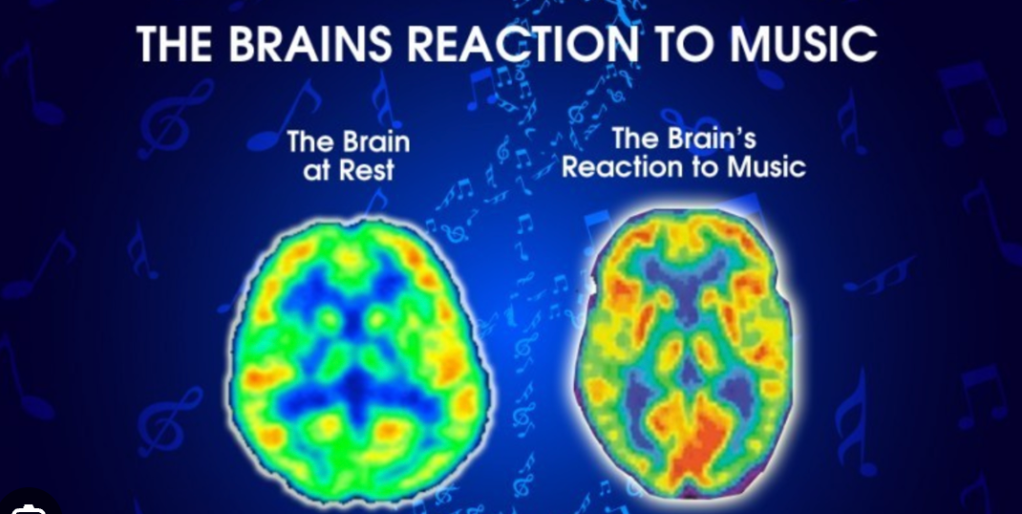
In this deep review of all sorts of music, the section that focused specifically on playing music revealed some more interesting facts. It mainly focused on the review of two types of studies in relation to playing music, the relation of brain activity from performer to listener, and from performer to performer. From the performer to the listener, specifically, the performance of drum beats showed activity in the right temporoparietal junction(TPJ), which is the junction of the temporal and parietal lobes. This area combines sensory information with internal body signals, which allows for the creation of empathy, self-awarness and attention. With another type of performer-to-listener pair, the performers were violinists, and in both the performer and the listener, the left TPJ, right inferior frontal cortex, and the central posterior cortex were activated. This means that as the performer was trying to convey emotions, the listener’s brain did pick up on it. The right inferior frontal cortex, which is an area specifically known for motor inhibition and empathy, was activated in the performer, most likely because of the motor skill of playing, and within the listener because their brain was mirroring the movements of the player. This is the reason why when we listen to music, we get the urge to tap our feet or move along with the music. Finally, the central posterior cortex was also activated, an area specifically known for sensory information and spatial awareness. For the performer, this part of the brain was likely activated for the spatial navigation of the instrument, like knowing where to place your fingers “automatically” while playing. The listener had this area activated to track the rhythm and pitch of the music to paint a mental picture. On the performer-to-performer side, many of the same areas of the brain were activated, but mainly for the reasons of physically playing the instrument. The main focus of attention is still the TPJ, which was the most activated area in all participants of the studies. Still, while looking at neuroimaging of someone playing an instrument, it lights up almost every part of your brain! (See image below)
Well, I hope you’ve learned something today. As always, stay curious, and if you’re a fellow musician, next time you play your instrument, just think about how many parts of your brain are working while you’re just doing something you love!
